Know Your Rights
Congress & Federal Government What does Congress do?
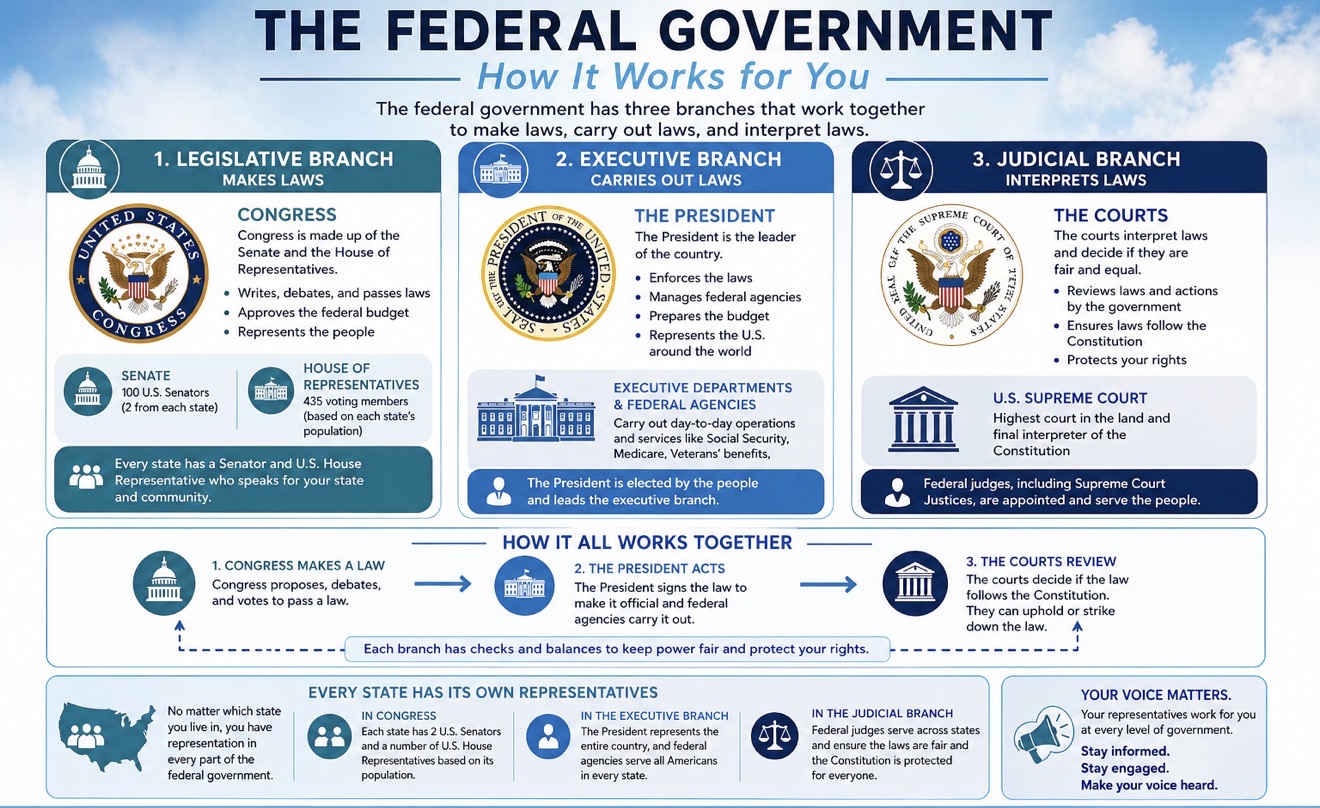
Congress is like the “team” that makes the big rules for the country. It has two parts — the House of Representatives and the Senate. Together, they decide on things that affect your daily life, such as:
•Healthcare and Medicare
•Jobs and the economy
•Housing and transportation
•Schools and public safety
•Civil rights and immigration
The President’s Role
The President works with Congress to make these decisions real.
•Congress writes the laws, and the President signs them to make them official — or vetoes them.
•Together, they decide how to spend money on roads, healthcare, and disaster relief.
•While the President speaks for the country, your Members of Congress speak for your community, making sure your voice is heard in Washington, D.C.
⸻
Meet Your Broward County Representatives

•Rep. Sheila Cherfilus-McCormick (FL-20) – Serving Sunrise, Plantation, Lauderdale Lakes, Fort Lauderdale, Pompano Beach, Tamarac, North Lauderdale, Deerfield, and parts of Palm Beach County, including the Glades.
Congresswoman Cherfilus-McCormick is a strong advocate for healthcare, jobs, housing, and equity for South Florida families.
How Sheila Helps Through Casework

Navigating federal systems like Social Security, Medicare, veterans’ benefits, housing assistance, or immigration can be confusing. Sheila’s office assists residents by:
•Immigration support: Helping constituents communicate with federal agencies, check the status of applications, and resolve issues with visas, green cards, or citizenship.
•Healthcare assistance: Helping navigate Medicare or Medicaid to ensure residents get the care they’re entitled to.
•Veterans’ services: Advocating for veterans to access their benefits.
•Housing and disaster relief: Connecting families to resources for safe and affordable housing and federal disaster assistance.
This kind of support is called Congressional casework — it ensures that South Floridians don’t just have laws written for them; they have direct help accessing federal programs and services.
⸻

The Fight Back Tour: Meeting Families, Fighting for Community
Rep. Cherfilus-McCormick is actively visiting her district through the Fight Back Tour, making over 100 stops to meet families, listen to their concerns, and provide solutions. At each stop, she:
•Engages directly with residents and community leaders
•Provides information and assistance with federal programs
•Brings local voices and concerns back to Washington, D.C.
The tour focuses on critical issues like affordable housing, healthcare access, civil rights, and economic opportunities. Sheila’s goal is to ensure that the needs of South Floridians are understood and addressed at the national level.
Visit her website for more information → cherfilus-mccormick.house.gov/fight-back-tour
⸻
Other Broward Representatives
•Rep. Jared Moskowitz (FL-23) – Coral Springs, Parkland, Oakland Park, Deerfield Beach
•Rep. Debbie Wasserman Schultz (FL-25) – Pembroke Pines, Weston, Miramar, Hollywood
Remember: You elect these Members of Congress. They represent YOUR voice in Washington, D.C., where decisions are made that impact your daily life. Find your Member of Congress here → congress.gov/members/find-your-member
Florida State Government

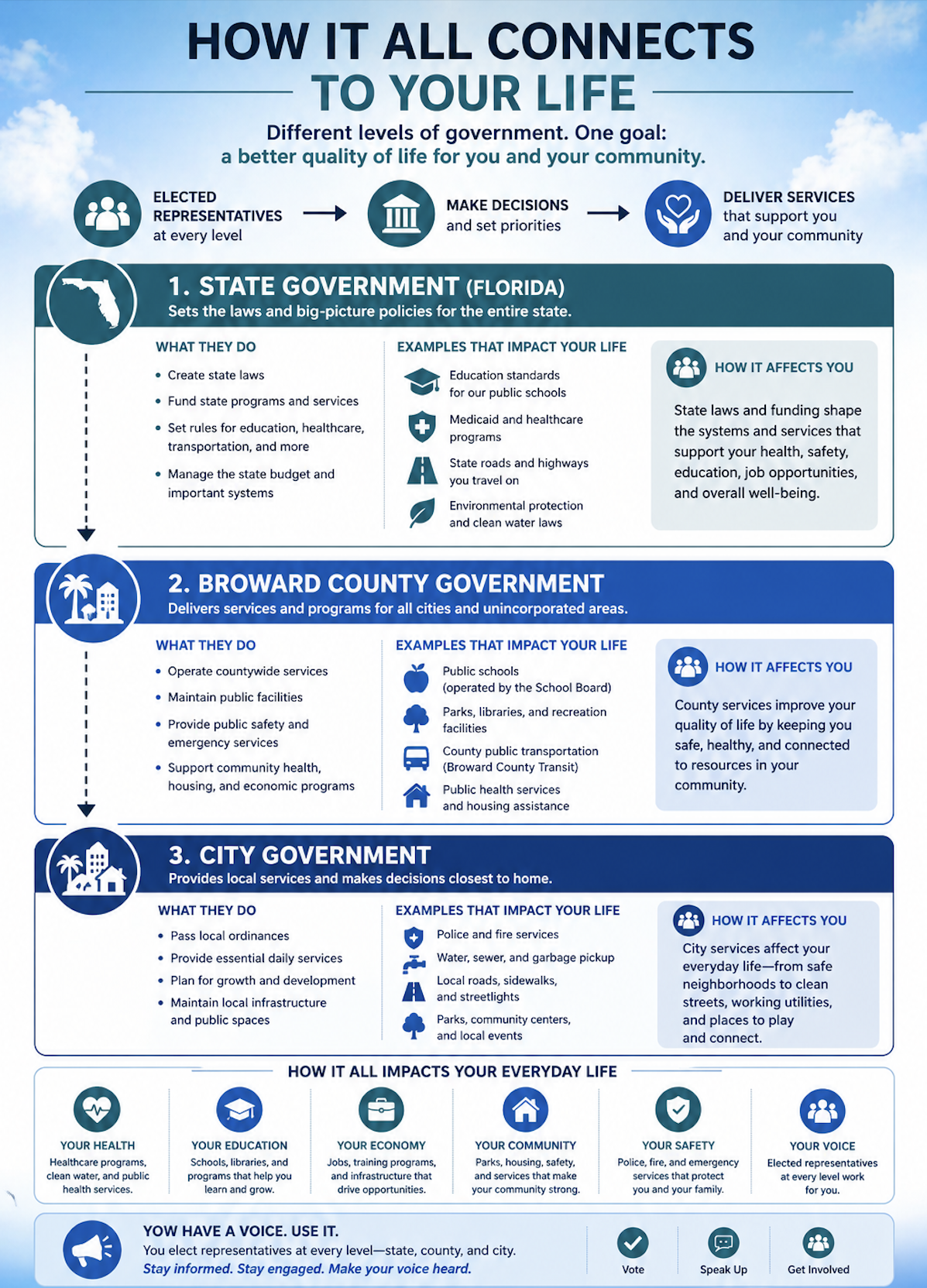
Florida has its own government, just like the United States does. Here’s how it works:
•State Representative: This is the person you vote for to speak up for your area in the Florida House of Representatives. There are 120 of them in Florida, and they make decisions about state laws.
•State Senator: This is another person you vote for who represents a bigger area. There are 40 state senators in Florida. They also help make state laws.
•Governor: The Governor is like the “President of Florida.” They make sure the laws are followed, work with schools, roads, and public safety, and can say yes or no to laws passed by the Legislature.
•State Agencies: These are state offices that carry out the work—like helping with driver’s licenses, unemployment benefits, and health programs.
In Simple Terms:
•State Representatives and Senators make the rules for Florida.
•The Governor enforces the rules and makes sure they’re followed.
•These people work at the state level, which is different from the federal level (Congress and the President).
Your City Government
What it does:
City government handles your everyday life — like parks, trash pickup, city roads, local police, and community events.
Your Mayor and City Commission decide how your city’s money is spent and what services get funded.
Broward County Government

What it does:
Broward County handles things like public transportation (BCT), public health, affordable housing, and countywide policies.
There are 9 County Commissioners who make decisions for all of Broward.
Link to Broward County Commission → https://www.broward.org/Commission/Pages/default.aspx
How Government Works Together
Government has different levels — but they’re all connected, and each one impacts your life in different ways:
Federal (Washington, D.C.)
•The President works with Congress (Senate + House of Representatives) to pass laws and set policies for the whole nation.
•Federal government touches things like immigration, Social Security, healthcare programs, and national safety.
State (Florida)
•Your State Senator and State Representative create laws for Florida, like rules on education, housing, and jobs.
•The Governor makes sure those laws are carried out and leads on issues that affect all Floridians.
Local (Broward County + Your City)
•Mayors, city commissioners, and county leaders handle things closest to you — like schools, parks, public safety, housing, and local programs.
•Local government is often where you can see change the fastest.
Why it matters
•Each level of government plays a role. What Congress decides can affect funding in Florida. What Florida decides can affect your city. And what your city does can impact your neighborhood.
•Knowing who does what gives you power — because you’ll know where to turn, who to call, and how to make your voice heard.
“When we understand how the pieces fit together, we can use our voice to shape the world around us.”
Understanding Federal Cuts
These numbers come from Congresswoman Sheila Cherfilus-McCormick’s office, which tracks how federal policies affect our district and Broward County.
Medicaid
•149,700 people rely on Medicaid in our district
•84,587 are children and 21,981 are seniors
•71% of Medicaid funding comes from the federal government
Recent changes in federal law are reducing support, which may mean more paperwork, new requirements, and fewer services covered.
SNAP (Food Assistance)
•50,958 households in our district depend on SNAP
•Nearly half include children, seniors, or people with disabilities
Federal changes are adding new rules that make it harder to qualify, which could reduce benefits for about 33,000 local families.
Voting Rights
•In Broward, 42% of voters safely used vote-by-mail in 2024
New proposals could limit vote-by-mail and add restrictions, making it harder for some—especially seniors and working families—to cast their ballots.
Why Are These Cuts Happening?
Congress recently passed a law that reduces federal spending in areas like health care, food assistance, and voting systems. The goal is to cut costs at the national level, but the impact is being felt most by children, seniors, and working families in our communities.
What This Means for Us
These numbers are a snapshot of one district, but they reflect a broader trend across Broward County and the entire country. Understanding these changes helps us:
•Prepare for what’s coming
•Support one another
•Protect access to care, food, and the ballot
Know Your Rights (Immigration)
Because knowing how the system works is the first step to making it work for you.
Know Your Rights
If approached by ICE agents or police
•You do not have to share your immigration status.
•You have the right to remain silent.
If ICE agents come to your home
•You do not have to open the door.
•Ask to see a search warrant — through a window or slid under the door.
•A deportation warrant is not the same as a search warrant and does not allow entry without your permission.
•You can refuse ICE entry if they don’t have a search warrant signed by a judge.
•If ICE enters without a valid warrant, ask for the agents’ names and badge numbers.
If you are arrested or detained
•You have the right to a lawyer immediately.
•You have the right to remain silent and not sign any documents until you speak to an attorney.
⸻
⚠️ REMEMBER
You have rights — stay calm, don’t argue, don’t run, and don’t lie.
Ask for a lawyer. Stay silent. Protect yourself
The above information is provided for informational/educational purposes & does not constitute legal advice.
Right to Remain Silent
You do not have to answer questions about your immigration status. You have the right to stay silent.
Right To Refuse Entry
ICE or police cannot enter your home without a valid search warrant signed by a judge.
Warrant Check
A deportation order is not the same as a search warrant-ask to see it through a window or under the door.
Right to a Lawyer
You have the right to speak to an attorney before signing anything or answering questions.